Just Accepted
Display Method:
Published:


Abstract:
This study investigates the transverse momentum (\begin{document}$ p_T $\end{document} \begin{document}$ \pi^{\mp} $\end{document} \begin{document}$ K^{\mp} $\end{document} \begin{document}$ \bar{p} $\end{document} \begin{document}$ K_s^0 $\end{document} \begin{document}$ \sqrt{s_{NN}} = 2.76 $\end{document} \begin{document}$ \langle p_T \rangle $\end{document} \begin{document}$ \langle T_0 \rangle $\end{document} \begin{document}$ \langle \beta_T \rangle $\end{document} \begin{document}$ \langle p_T \rangle $\end{document} \begin{document}$ \langle T_0 \rangle $\end{document} \begin{document}$ \langle \beta_T \rangle $\end{document}
This study investigates the transverse momentum (


Published:
, doi: 10.1088/1674-1137/ae368b
Abstract:
We measured the 19O+12C fusion excitation function using the MATE active-target TPC at IMP for\begin{document}$ 9.7 \leqslant E_{\rm{c.m.}} \leqslant 16.9$\end{document} \begin{document}$ 1/E_{\rm{cr}}$\end{document}
We measured the 19O+12C fusion excitation function using the MATE active-target TPC at IMP for


Published:
Abstract:
Within the framework of the macroscopic-microscopic model by using total-Routhian-surface calculations in the three-dimensional space (\begin{document}$ \beta_2 $\end{document} \begin{document}$ \beta_4 $\end{document} \begin{document}$ R_{4/2} $\end{document} \begin{document}$ E_{2_1^+} $\end{document} \begin{document}$ E_{\rm{bind}} $\end{document} \begin{document}$ \beta_2 $\end{document} \begin{document}$ \beta_4 $\end{document} \begin{document}$ 1g_{9/2} $\end{document}
Within the framework of the macroscopic-microscopic model by using total-Routhian-surface calculations in the three-dimensional space (


Published:
Abstract:
We investigate thermal photon production in the quark-gluon plasma (QGP) under strong magnetic fields using a magnetohydrodynamic (MHD) framework. Adopting the Bjorken flow model with power-law decaying magnetic fields\begin{document}$ \mathbf{B}(\tau) = \mathbf{B}_0 (\tau_0/\tau)^a $\end{document} \begin{document}$ B_0 = \sqrt{\sigma} T_0^2 $\end{document} \begin{document}$ q\bar{q} $\end{document} \begin{document}$ q\bar{q} $\end{document} \begin{document}$ (p_T) $\end{document} \begin{document}$ p_T $\end{document} \begin{document}$ a \to \infty $\end{document} \begin{document}$ a = 2/3 $\end{document} \begin{document}$ a \to \infty $\end{document} \begin{document}$ p_T $\end{document} \begin{document}$ p_T $\end{document} \begin{document}$ (y=0) $\end{document}
We investigate thermal photon production in the quark-gluon plasma (QGP) under strong magnetic fields using a magnetohydrodynamic (MHD) framework. Adopting the Bjorken flow model with power-law decaying magnetic fields


Published:
Abstract:
Using four representative nuclear mass models, namely WS4, FRDM, DZ10, and KTUY, we perform a systematic investigation on how nuclear masses affect α-decay properties of superheavy nuclei, including decay energies, α-cluster preformation factors, and corresponding half-lives. The α-cluster preformation factors are obtained from two types of cluster-formation model (CFM) and also extracted from experimental decay half-life. All mass models reproduce the known α-decay energies with small root-mean-square errors, while WS4 and FRDM show the highest accuracy. Strong correlations among preformation factors from different mass models are identified in both CFM and extracted results, although the exponential dependence of half-lives on decay energy weakens correlations between the two approaches. For possible α-decay chains of superheavy nuclei, the decay energy systematically decreases and the predicted half-life increases with the decreasing proton number. This tendency is also observed from the calculations for superheavy isotopes with same proton number. These results indicate that isotopes of superheavy elements with more neutrons are expected to exhibit enhanced stability, providing theoretical reference for future synthesis of elements with Z=119 and 120.
Using four representative nuclear mass models, namely WS4, FRDM, DZ10, and KTUY, we perform a systematic investigation on how nuclear masses affect α-decay properties of superheavy nuclei, including decay energies, α-cluster preformation factors, and corresponding half-lives. The α-cluster preformation factors are obtained from two types of cluster-formation model (CFM) and also extracted from experimental decay half-life. All mass models reproduce the known α-decay energies with small root-mean-square errors, while WS4 and FRDM show the highest accuracy. Strong correlations among preformation factors from different mass models are identified in both CFM and extracted results, although the exponential dependence of half-lives on decay energy weakens correlations between the two approaches. For possible α-decay chains of superheavy nuclei, the decay energy systematically decreases and the predicted half-life increases with the decreasing proton number. This tendency is also observed from the calculations for superheavy isotopes with same proton number. These results indicate that isotopes of superheavy elements with more neutrons are expected to exhibit enhanced stability, providing theoretical reference for future synthesis of elements with Z=119 and 120.


Published:
Abstract:
This study systematically investigates the cosmological dynamics of two well-motivated functional forms in\begin{document}$f(T,B)$\end{document} \begin{document}$f(T,B) = - T + B$\end{document} \begin{document}$f(T,B) = c_1 T^\alpha B^\beta$\end{document} \begin{document}$f(T,B) = c_2 T^\alpha + c_3 B^\beta$\end{document} \begin{document}$f(T,B)$\end{document}
This study systematically investigates the cosmological dynamics of two well-motivated functional forms in


Published:
Abstract:
The neutron total cross section (\begin{document}$ \sigma_{t} $\end{document} \begin{document}$ \sigma_{t} $\end{document} \begin{document}$ \sigma_{t} $\end{document} \begin{document}$ \sigma_{t} $\end{document}
The neutron total cross section (


Published:
Abstract:
We propose a novel method for extracting non-singlet (NS) fragmentation functions (FFs) of light charged hadrons from charge asymmetries measured in hadron fragmentation, using data from both single-inclusive electron-positron annihilation and semi-inclusive deep-inelastic scattering processes. We determine the NS FFs for pions and kaons at next-to-next-to-leading order in Quantum Chromodynamics, including a comprehensive uncertainty analysis. The extracted FFs reveal a scaling index of about 0.7 at large momentum fractions and low energy scales, a strangeness suppression factor of about 0.5, and universality in fragmentation of light mesons. Our findings provide a valuable benchmark for testing non-perturbative QCD models and Monte Carlo event generators, and serve as crucial input for future electron-ion colliders.
We propose a novel method for extracting non-singlet (NS) fragmentation functions (FFs) of light charged hadrons from charge asymmetries measured in hadron fragmentation, using data from both single-inclusive electron-positron annihilation and semi-inclusive deep-inelastic scattering processes. We determine the NS FFs for pions and kaons at next-to-next-to-leading order in Quantum Chromodynamics, including a comprehensive uncertainty analysis. The extracted FFs reveal a scaling index of about 0.7 at large momentum fractions and low energy scales, a strangeness suppression factor of about 0.5, and universality in fragmentation of light mesons. Our findings provide a valuable benchmark for testing non-perturbative QCD models and Monte Carlo event generators, and serve as crucial input for future electron-ion colliders.


Production of medical radioisotopes 51Cr, 62,64Cu, and 99mTc by laser-induced photonuclear reactions
Published:
Abstract:
Laser-driven bremsstrahlung photon sources offer a promising approach to producing medical radioisotopes by photonuclear reactions. In this work, we report new activation measurements of natCr, natCu, and natRu by laser-driven bremsstrahlung at Peking University’s Compact Laser Plasma Accelerator laboratory. It utilized the 200 TW laser with a 0.2 Hz repetition frequency and 2-mm-thick targets. An activity of 2.27 Bq for 51Cr, 5110 Bq for 62Cu, 53.9 Bq for 64Cu, and 16.4 Bq for 99mTc has been achieved after a 20-30 minutes' irradiation. These crucial data, together with the dedicated Monte Carlo simulations, enable a realistic evaluation to address the growing demand in nuclear medicine. It is found that utilizing a repetition frequency of 100 Hz for the 200 TW laser and 10-cm-thick targets can meet the clinical diagnostic requirements of a typical activity of MBq for the isotopes of interest.
Laser-driven bremsstrahlung photon sources offer a promising approach to producing medical radioisotopes by photonuclear reactions. In this work, we report new activation measurements of natCr, natCu, and natRu by laser-driven bremsstrahlung at Peking University’s Compact Laser Plasma Accelerator laboratory. It utilized the 200 TW laser with a 0.2 Hz repetition frequency and 2-mm-thick targets. An activity of 2.27 Bq for 51Cr, 5110 Bq for 62Cu, 53.9 Bq for 64Cu, and 16.4 Bq for 99mTc has been achieved after a 20-30 minutes' irradiation. These crucial data, together with the dedicated Monte Carlo simulations, enable a realistic evaluation to address the growing demand in nuclear medicine. It is found that utilizing a repetition frequency of 100 Hz for the 200 TW laser and 10-cm-thick targets can meet the clinical diagnostic requirements of a typical activity of MBq for the isotopes of interest.


Published:
, doi: 10.1088/1674-1137/ae3072
Abstract:
The theoretical prediction on the the in-medium\begin{document}$NN\rightarrow N\Delta$\end{document} \begin{document}$R=\sigma^*_{NN\rightarrow N\Delta}/\sigma^{free}_{NN\rightarrow N\Delta}$\end{document}
The theoretical prediction on the the in-medium


Published:
Abstract:
A phenomenological model is proposed for a systematic description of the spontaneous fission (SF) half-lives\begin{document}$T_{\rm SF}$\end{document} \begin{document}$17$\end{document} \begin{document}$45\leqslant N-Z \leqslant 61$\end{document} \begin{document}$N=184$\end{document} \begin{document}$T_{\rm SF}$\end{document} \begin{document}$^{304}$\end{document} \begin{document}$^{298}$\end{document} \begin{document}$10 \sim 160$\end{document} \begin{document}$T_{\rm SF}$\end{document} \begin{document}$^{293}119 $\end{document}
A phenomenological model is proposed for a systematic description of the spontaneous fission (SF) half-lives


Published:
Abstract:
We present a unified investigation of black hole shadows, quasinormal modes (QNMs), and greybody factors (GBFs) for a static, spherically symmetric black hole within a composite environment of a modified Chaplygin-like dark fluid (MCDF) and a cloud of strings (CoS). We examine the structure of critical photon orbits and the corresponding optical appearance under spherical accretion. Using the Wentzel–Kramers–Brillouin (WKB) approximation, we compute the quasinormal frequencies and greybody spectra, and explore their correspondence with the black hole shadows in the eikonal limit. A systematic parameter study demonstrates that the CoS intensity has the primary influence on the shadows, QNMs and GBFs, while the MCDF parameters introduce more complex but characterizable modifications to each. Our results demonstrate that these environmental components imprint distinct yet interrelated signatures on key observables, offering specific predictions for probing exotic black hole environments.
We present a unified investigation of black hole shadows, quasinormal modes (QNMs), and greybody factors (GBFs) for a static, spherically symmetric black hole within a composite environment of a modified Chaplygin-like dark fluid (MCDF) and a cloud of strings (CoS). We examine the structure of critical photon orbits and the corresponding optical appearance under spherical accretion. Using the Wentzel–Kramers–Brillouin (WKB) approximation, we compute the quasinormal frequencies and greybody spectra, and explore their correspondence with the black hole shadows in the eikonal limit. A systematic parameter study demonstrates that the CoS intensity has the primary influence on the shadows, QNMs and GBFs, while the MCDF parameters introduce more complex but characterizable modifications to each. Our results demonstrate that these environmental components imprint distinct yet interrelated signatures on key observables, offering specific predictions for probing exotic black hole environments.


Published:
Abstract:
In this paper, we have systematically explored the mass spectrum of fully strange tetraquark candidates within the framework of QCD sum rules, focusing on states with quantum numbers\begin{document}$ J^{PC}=0^{++} $\end{document} \begin{document}$ 0^{-+} $\end{document} \begin{document}$ 0^{--} $\end{document} \begin{document}$ 1^{--} $\end{document} \begin{document}$ 1^{+-} $\end{document} \begin{document}$ 1^{++} $\end{document} \begin{document}$ 2.07 $\end{document} \begin{document}$ 3.12 $\end{document} \begin{document}$ X(2300) $\end{document}
In this paper, we have systematically explored the mass spectrum of fully strange tetraquark candidates within the framework of QCD sum rules, focusing on states with quantum numbers


Published:
Abstract:
The cross-sections of 39K(n, p)39Ar at the 2-3 MeV energy play an important role in nuclear structure research and 40Ar/39Ar geochronology application. Due to the limitations of n-3He coincidence technology and counting instruments, the published data from the literature are before 1967, and the existing data are scarce and of significant divergence. Meanwhile, there are large discrepancies between the measured and evaluation results. By taking advantage of the high sensitivity and resolution noble gas mass spectrometer at Institute of Geology and Geophysics, Chinese Academy of Sciences (IGGCAS), the cross-section of 39K(n, p)39Ar were measured by the methods of combined neutron activity analysis and noble gas mass spectrometry techniques, and the uncertainties were discussed in detail. The cross-section of 39K(n, p)39Ar were measured as 103.84 ± 16.33, 109.76 ± 15.88, 150.27 ± 24.19 mb, at 2.56 ± 0.08, 2.69 ± 0.08, 2.96 ± 0.12 MeV energies respectively. The measured data filled the data gaps and provided more accurate data support for 40Ar/39Ar dating. Furthermore the theoretical excitation function of 39K(n, p)39Ar was calculated using TALYS-1.97 computer codes. Then the experimentally determined cross-sections were analyzed by comparing with literature data available in EXFOR database and evaluated nuclear data in ENDF/B-VIII.0, JEFF-3.2, TENDL-2021, BROND-3.1, and JENDL-5 databases. According to comparative results, the measured cross-sections of 39K(n, p)39Ar exhibit a rapid energy-dependent increase between 2-3 MeV, aligning with higher literature values and resolving previous discrepancies. Compared with the previously reported data, the precision of determined cross-sections in this work have great improvement. The comparison of measured data indicates that the combined detection method of neutron activity analysis and noble gas mass spectrometry techniques is suitable for measuring cross-sections of long-life product nuclei nuclear reaction and the application of 40Ar/39Ar geochronology with D-D neutron source.
The cross-sections of 39K(n, p)39Ar at the 2-3 MeV energy play an important role in nuclear structure research and 40Ar/39Ar geochronology application. Due to the limitations of n-3He coincidence technology and counting instruments, the published data from the literature are before 1967, and the existing data are scarce and of significant divergence. Meanwhile, there are large discrepancies between the measured and evaluation results. By taking advantage of the high sensitivity and resolution noble gas mass spectrometer at Institute of Geology and Geophysics, Chinese Academy of Sciences (IGGCAS), the cross-section of 39K(n, p)39Ar were measured by the methods of combined neutron activity analysis and noble gas mass spectrometry techniques, and the uncertainties were discussed in detail. The cross-section of 39K(n, p)39Ar were measured as 103.84 ± 16.33, 109.76 ± 15.88, 150.27 ± 24.19 mb, at 2.56 ± 0.08, 2.69 ± 0.08, 2.96 ± 0.12 MeV energies respectively. The measured data filled the data gaps and provided more accurate data support for 40Ar/39Ar dating. Furthermore the theoretical excitation function of 39K(n, p)39Ar was calculated using TALYS-1.97 computer codes. Then the experimentally determined cross-sections were analyzed by comparing with literature data available in EXFOR database and evaluated nuclear data in ENDF/B-VIII.0, JEFF-3.2, TENDL-2021, BROND-3.1, and JENDL-5 databases. According to comparative results, the measured cross-sections of 39K(n, p)39Ar exhibit a rapid energy-dependent increase between 2-3 MeV, aligning with higher literature values and resolving previous discrepancies. Compared with the previously reported data, the precision of determined cross-sections in this work have great improvement. The comparison of measured data indicates that the combined detection method of neutron activity analysis and noble gas mass spectrometry techniques is suitable for measuring cross-sections of long-life product nuclei nuclear reaction and the application of 40Ar/39Ar geochronology with D-D neutron source.


Published:
Abstract:
Small neutrino masses can be generated through the well-known seesaw mechanisms, among which the type-II scenario predicts a triplet scalar with doubly charged components. Except for the Drell-Yan production at the Large Hadron Collider (LHC), the doubly charged scalars\begin{document}$\Delta^{\pm\pm}$\end{document} \begin{document}$\mu^{+}\mu^{+}\mu^{-}\mu^{-}$\end{document} \begin{document}$e^{+}e^{+}e^{-}e^{-}$\end{document} \begin{document}$^{-1}$\end{document} \begin{document}$m_{\Delta}\sim430(520)$\end{document} \begin{document}$\mu^{+}\mu^{+}\mu^{-}\mu^{-}$\end{document} \begin{document}$e^{+}e^{+}e^{-}e^{-}$\end{document} \begin{document}$m_{\Delta}$\end{document} \begin{document}$^{-1}$\end{document}
Small neutrino masses can be generated through the well-known seesaw mechanisms, among which the type-II scenario predicts a triplet scalar with doubly charged components. Except for the Drell-Yan production at the Large Hadron Collider (LHC), the doubly charged scalars


Published:
, doi: 10.1088/1674-1137/ae2b5e
Abstract:
We investigate the collider signatures of the maximally flavor-violating\begin{document}$ U(1)_{L_\mu-L_\tau} $\end{document} \begin{document}$ Z^\prime $\end{document} \begin{document}$ m_{Z^\prime} $\end{document} \begin{document}$ \tilde{g}/m_{Z^\prime} $\end{document} \begin{document}$ m_{Z^\prime} $\end{document} \begin{document}$ U(1)_{L\mu - L_\tau} $\end{document}
We investigate the collider signatures of the maximally flavor-violating


Published:
, doi: 10.1088/1674-1137/ae28eb
Abstract:
We investigate geodesic motion and gravitational-wave signatures of charged black holes with scalar hair. Using the effective potential approach, we analyze marginally bound orbits and innermost stable circular orbits, showing how their positions and energy thresholds are modified by the scalar hair parameter\begin{document}$ r_B $\end{document} ![]()
![]()
\begin{document}$ (z,w,v) $\end{document} ![]()
![]()
\begin{document}$ r_B $\end{document} ![]()
![]()
We investigate geodesic motion and gravitational-wave signatures of charged black holes with scalar hair. Using the effective potential approach, we analyze marginally bound orbits and innermost stable circular orbits, showing how their positions and energy thresholds are modified by the scalar hair parameter


Published:
, doi: 10.1088/1674-1137/ae25c9
Abstract:
In this work, we systematically investigate baryon number violating (BNV) nucleon decays into an axion-like particle (ALP), within a low energy effective field theory extended with an ALP, named as aLEFT. Unlike previous studies in the literature, we consider contributions to nucleon decays from a complete set of dimension-eight BNV aLEFT operators involving light u, d, s quarks. We perform the chiral irreducible representation (irrep) decomposition of all those interactions under the QCD chiral group\begin{document}${\rm{SU}}(3)_{\mathtt{L}}\times {\rm{SU}}(3)_{\mathtt{R}}$\end{document} ![]()
![]()
\begin{document}${\bf{6}}_{{\mathtt{L}}({\mathtt{R}})}\times {\bf{3}}_{{\mathtt{R}}({\mathtt{L}})}$\end{document} ![]()
![]()
\begin{document}${\bf{8}}_{{\mathtt{L}}({\mathtt{R}})}\times \pmb{1}_{{\mathtt{R}}({\mathtt{L}})}$\end{document} ![]()
![]()
\begin{document}${\bf{3}}_{{\mathtt{L}}({\mathtt{R}})}\times \bar{{\bf{3}}}_{{\mathtt{R}}({\mathtt{L}})}$\end{document} ![]()
![]()
In this work, we systematically investigate baryon number violating (BNV) nucleon decays into an axion-like particle (ALP), within a low energy effective field theory extended with an ALP, named as aLEFT. Unlike previous studies in the literature, we consider contributions to nucleon decays from a complete set of dimension-eight BNV aLEFT operators involving light u, d, s quarks. We perform the chiral irreducible representation (irrep) decomposition of all those interactions under the QCD chiral group


Published:
Abstract:
This work aims to analyze how hyperons affect neutrino radiation properties in nucleonic direct URCA processes, with the goal of providing useful references for identifying evidence of hyperons in astronomical observations. This analysis is conducted using the GM1 and NL3 parameter sets under the SU(6) and SU(3) flavor symmetries within the relativistic mean field theory framework. In conjunction with the inferred mass and radius values of PSRs J1231-1411, J0030+0451, and J0740+6620, our results indicate that nucleonic direct URCA processes are absent in PSR J1231-1411 due to momentum conservation violation. In the hyperon-containing PSR J0030+0451 (NL3 parameter set), the nucleonic direct URCA processes involving\begin{document}$e^{-}$\end{document} ![]()
![]()
\begin{document}$\mu^{-}$\end{document} ![]()
![]()
\begin{document}$M_{\odot}$\end{document} ![]()
![]()
This work aims to analyze how hyperons affect neutrino radiation properties in nucleonic direct URCA processes, with the goal of providing useful references for identifying evidence of hyperons in astronomical observations. This analysis is conducted using the GM1 and NL3 parameter sets under the SU(6) and SU(3) flavor symmetries within the relativistic mean field theory framework. In conjunction with the inferred mass and radius values of PSRs J1231-1411, J0030+0451, and J0740+6620, our results indicate that nucleonic direct URCA processes are absent in PSR J1231-1411 due to momentum conservation violation. In the hyperon-containing PSR J0030+0451 (NL3 parameter set), the nucleonic direct URCA processes involving


Published:
, doi: 10.1088/1674-1137/ae039d
Abstract:
The theoretical study aims to synthesize superheavy elements with\begin{document}$ Z \geq 114 $\end{document} ![]()
![]()
\begin{document}$^{48}\text{Ca}$\end{document} ![]()
![]()
\begin{document}$ \mathrm{^{244}Pu}(\mathrm{^{50}Ti}, \, \mathit{x} n)\, \mathrm{^{294-\mathit{x}}Lv} $\end{document} ![]()
![]()
\begin{document}$ \mathrm{^{50}Ti} $\end{document} ![]()
![]()
\begin{document}$ \mathrm{^{54}Cr} $\end{document} ![]()
![]()
\begin{document}$ \mathrm{^{249}Bk}(\mathrm{^{50}Ti}, \, \mathit{x} n)\, \mathrm{^{299-\mathit{x}}119} $\end{document} ![]()
![]()
\begin{document}$ \sigma_{\mathrm{prod}} = 21.72 $\end{document} ![]()
![]()
\begin{document}$ \mathrm{^{249}Cf}(\mathrm{^{50}Ti}, \, \mathit{x} n)\, \mathrm{^{299-\mathit{x}}120} $\end{document} ![]()
![]()
\begin{document}$ \sigma_{\mathrm{prod}} = 1.80 $\end{document} ![]()
![]()
\begin{document}$ \mathrm{^{50}Ti} $\end{document} ![]()
![]()
\begin{document}$ Z = 118 $\end{document} ![]()
![]()
The theoretical study aims to synthesize superheavy elements with


Published:
Abstract:
Experimental and theoretical investigation of the fragmentation reaction in Fermi-energy domain is currently of particular importance for not only the nuclear physics but also some interdisciplinary fields. In the present work, neutron-rich 14C and 16C ion beams at 27.5 MeV/nucleon were used to bombard carbon and polyethylene (CD2)n targets. Energy and angular distributions of the produced fragments were measured. Background events originating from the carbon content in (CD2)n target were efficiently excluded using an extended E-P plot method. Experimental results are systematically analyzed by using HIPSE-SIMON dynamic model. The comparison reveals that, for the carbon target, the HIPSE-SIMON calculation overestimates the yields of the beam-velocity component for fragments near the projectile and also the energy phase space for fragments far away from the projectile, suggesting fine tuning of the overall interaction profile adopted in the model. In contrast, for reactions with the deuteron target, the model calculation can reasonably reproduce the experimental data. The implication of the fragmentation mechanism to the validity of the invariant mass method, as frequently used to reconstruct the clustering resonant structures in light nuclei, is also discussed.
Experimental and theoretical investigation of the fragmentation reaction in Fermi-energy domain is currently of particular importance for not only the nuclear physics but also some interdisciplinary fields. In the present work, neutron-rich 14C and 16C ion beams at 27.5 MeV/nucleon were used to bombard carbon and polyethylene (CD2)n targets. Energy and angular distributions of the produced fragments were measured. Background events originating from the carbon content in (CD2)n target were efficiently excluded using an extended E-P plot method. Experimental results are systematically analyzed by using HIPSE-SIMON dynamic model. The comparison reveals that, for the carbon target, the HIPSE-SIMON calculation overestimates the yields of the beam-velocity component for fragments near the projectile and also the energy phase space for fragments far away from the projectile, suggesting fine tuning of the overall interaction profile adopted in the model. In contrast, for reactions with the deuteron target, the model calculation can reasonably reproduce the experimental data. The implication of the fragmentation mechanism to the validity of the invariant mass method, as frequently used to reconstruct the clustering resonant structures in light nuclei, is also discussed.


Published:
, doi: 10.1088/1674-1137/ae1f07
Abstract:
In this work, we perform a microscopic study of proton decay half-lives in neutron-deficient nuclei using the Hartree-Fock-Bogolyubov (HFB) approach with the Gogny D1S effective interaction. Proton emission half-lives from both ground and isomeric states are computed employing a single-folding potential constructed from the realistic M3Y-Paris nucleon-nucleon interaction. The deformed density distributions of the daughter nuclei are calculated self-consistently within the same HFB framework. The resulting decay half-lives are systematically compared with recent experimental measurements and other theoretical models to evaluate the accuracy and predictive capacity of this fully microscopic methodology in describing proton radioactivity near the proton dripline.
In this work, we perform a microscopic study of proton decay half-lives in neutron-deficient nuclei using the Hartree-Fock-Bogolyubov (HFB) approach with the Gogny D1S effective interaction. Proton emission half-lives from both ground and isomeric states are computed employing a single-folding potential constructed from the realistic M3Y-Paris nucleon-nucleon interaction. The deformed density distributions of the daughter nuclei are calculated self-consistently within the same HFB framework. The resulting decay half-lives are systematically compared with recent experimental measurements and other theoretical models to evaluate the accuracy and predictive capacity of this fully microscopic methodology in describing proton radioactivity near the proton dripline.


Published:
Abstract:
We investigate the discovery prospects of a leptophilic gauge boson\begin{document}$ Z_\ell $\end{document} ![]()
![]()
\begin{document}$ e^+e^- $\end{document} ![]()
![]()
\begin{document}$ U(1)'_\ell $\end{document} ![]()
![]()
\begin{document}$ e^+e^- \to \mu^+\mu^- $\end{document} ![]()
![]()
\begin{document}$ \sqrt{s}=240 $\end{document} ![]()
![]()
\begin{document}$ g_\ell \approx 10^{-3} $\end{document} ![]()
![]()
\begin{document}$ Z_\ell $\end{document} ![]()
![]()
\begin{document}$ \sqrt{s} $\end{document} ![]()
![]()
We investigate the discovery prospects of a leptophilic gauge boson


Published:
Abstract:
We employ a comprehensive set of relativistic mean-field (RMF) models to investigate the role of hyperons (Λ,\begin{document}$ \Sigma^{\pm,0} $\end{document} ![]()
![]()
\begin{document}$ \Xi^{-,0} $\end{document} ![]()
![]()
\begin{document}$ _{max} $\end{document} ![]()
![]()
\begin{document}$ _{max} $\end{document} ![]()
![]()
\begin{document}$ \Lambda_{max} $\end{document} ![]()
![]()
\begin{document}$ X_{\omega Y} $\end{document} ![]()
![]()
\begin{document}$ X_{\omega Y} $\end{document} ![]()
![]()
\begin{document}$ X_{\omega Y} $\end{document} ![]()
![]()
\begin{document}$ \Xi^- $\end{document} ![]()
![]()
\begin{document}$ \Xi^0 $\end{document} ![]()
![]()
\begin{document}$ _{max} $\end{document} ![]()
![]()
\begin{document}$ _{max} $\end{document} ![]()
![]()
\begin{document}$ \Lambda_{max} $\end{document} ![]()
![]()
\begin{document}$ _{1.4} $\end{document} ![]()
![]()
\begin{document}$ \Lambda_{1.4} $\end{document} ![]()
![]()
\begin{document}$ _{\odot} $\end{document} ![]()
![]()
\begin{document}$ _{1.4} $\end{document} ![]()
![]()
\begin{document}$ \Lambda_{1.4} $\end{document} ![]()
![]()
\begin{document}$ _{max} $\end{document} ![]()
![]()
\begin{document}$ \ge $\end{document} ![]()
![]()
\begin{document}$ _{\odot} $\end{document} ![]()
![]()
\begin{document}$ _{\omega Y} $\end{document} ![]()
![]()
\begin{document}$ _{\omega Y} $\end{document} ![]()
![]()
\begin{document}$ _{\odot} $\end{document} ![]()
![]()
We employ a comprehensive set of relativistic mean-field (RMF) models to investigate the role of hyperons (Λ,


Published:
Abstract:
The study examines the impact of higher-order deformations up to hexacontatetrapole (\begin{document}$ \beta_6 $\end{document} ![]()
![]()
\begin{document}$ \beta_6 $\end{document} ![]()
![]()
\begin{document}$ V_B $\end{document} ![]()
![]()
\begin{document}$ R_B $\end{document} ![]()
![]()
\begin{document}$ \pm $\end{document} ![]()
![]()
\begin{document}$ \beta_6 $\end{document} ![]()
![]()
\begin{document}$ \beta_6 $\end{document} ![]()
![]()
\begin{document}$ \beta_2 $\end{document} ![]()
![]()
\begin{document}$ \beta_4 $\end{document} ![]()
![]()
\begin{document}$ \beta_6 $\end{document} ![]()
![]()
\begin{document}$ \sigma_{cap} $\end{document} ![]()
![]()
\begin{document}$ \beta_6 $\end{document} ![]()
![]()
\begin{document}$ \beta_2 $\end{document} ![]()
![]()
\begin{document}$ \beta_4 $\end{document} ![]()
![]()
\begin{document}$ \beta_2\beta_4 $\end{document} ![]()
![]()
\begin{document}$ \beta_6 $\end{document} ![]()
![]()
The study examines the impact of higher-order deformations up to hexacontatetrapole (


Published:
Abstract:
We investigate the bound-state equations in two-dimensional QCD in the\begin{document}$ N_c\to \infty $\end{document} ![]()
![]()
We investigate the bound-state equations in two-dimensional QCD in the


Published:
, doi: 10.1088/1674-1137/ae3602
Abstract:
In this article, we investigate the possibility of enhancing the di-jet resonance searches by tagging the final state radiation (FSR) jet, using an event-level deep neural network. It is found that solely relying on the 4-momenta of the leading three jets allows the algorithm to achieve good discriminating power that can identify the hardest FSR jet in signal, while rejecting other soft jets. Once the invariant mass is corrected with the tagged FSR jet, the mass resolution of the signal is greatly enhanced, and the sensitivity of the search is also improved by more than 10%. By crafting the input variables carefully, the algorithm introduces minimal mass sculpting for the background, and its applicability extends to a broad mass range. This work proves that FSR jet tagging can potentially enhance the di-jet resonance searches, suiting various stages of the physics programmes at the Large Hadron Collider (LHC) and High-Luminosity LHC (HL-LHC).
In this article, we investigate the possibility of enhancing the di-jet resonance searches by tagging the final state radiation (FSR) jet, using an event-level deep neural network. It is found that solely relying on the 4-momenta of the leading three jets allows the algorithm to achieve good discriminating power that can identify the hardest FSR jet in signal, while rejecting other soft jets. Once the invariant mass is corrected with the tagged FSR jet, the mass resolution of the signal is greatly enhanced, and the sensitivity of the search is also improved by more than 10%. By crafting the input variables carefully, the algorithm introduces minimal mass sculpting for the background, and its applicability extends to a broad mass range. This work proves that FSR jet tagging can potentially enhance the di-jet resonance searches, suiting various stages of the physics programmes at the Large Hadron Collider (LHC) and High-Luminosity LHC (HL-LHC).


Published:
Abstract:
Neutrino oscillation experiments have confirmed that neutrinos are massive particles and lepton flavors are mixed. To explain the observed lepton mass spectra and flavor mixing patterns, flavor symmetry plays a crucial and unique role. In this paper, we propose a useful symmetry-breaking scheme by applying\begin{document}$S_{3L} \times S_{3R} \rightarrow S_{2L} \times S_{2R} \rightarrow \emptyset$\end{document} \begin{document}$S_{2L}^{(23)} \times S_{2R}^{(23)}$\end{document} \begin{document}$S_{2L}^{(13)} \times S_{2R}^{(13)}$\end{document} \begin{document}$S_{2L}^{(12)} \times S_{2R}^{(12)}$\end{document} \begin{document}$294.6^\circ$\end{document} \begin{document}$302.3^\circ$\end{document} \begin{document}$287.0^\circ$\end{document} \begin{document}$3\sigma$\end{document} \begin{document}$281.2^\circ \rightarrow 338.7^\circ$\end{document} \begin{document}$287.0^\circ \rightarrow 342.2^\circ$\end{document} \begin{document}$282.7^\circ \rightarrow 297.0^\circ$\end{document} \begin{document}$3\sigma$\end{document} \begin{document}$S_{3L} \times S_{3R} \rightarrow S_{2L} \times S_{2R} \rightarrow \emptyset$\end{document}
Neutrino oscillation experiments have confirmed that neutrinos are massive particles and lepton flavors are mixed. To explain the observed lepton mass spectra and flavor mixing patterns, flavor symmetry plays a crucial and unique role. In this paper, we propose a useful symmetry-breaking scheme by applying


Published:
, doi: 10.1088/1674-1137/ad8ec2
Abstract:
The direct CP asymmetry in the weak decay process of hadrons is commonly attributed to the weak phase of the CKM matrix and the indeterminate strong phase. We propose a method to generate a significant phase difference through the interference between ρ and ω mesons, taking into account the G-parity allowed decay process of\begin{document}$\omega \rightarrow \pi^{+}\pi^{-}\pi^{0}$\end{document} ![]()
![]()
\begin{document}$\rho^{0} \rightarrow \pi^{+}\pi^{-}\pi^{0}$\end{document} ![]()
![]()
The direct CP asymmetry in the weak decay process of hadrons is commonly attributed to the weak phase of the CKM matrix and the indeterminate strong phase. We propose a method to generate a significant phase difference through the interference between ρ and ω mesons, taking into account the G-parity allowed decay process of


Published:
Abstract:
We investigated a time-varying cosmological constant model using recent BAO measurements from DESI DR2, combined with Type Ia supernova samples (Pantheon\begin{document}$^{+}$\end{document} \begin{document}$\Lambda(t)$\end{document} \begin{document}$P_1,P_2$\end{document} \begin{document}$P_3$\end{document} \begin{document}$\Lambda(t)$\end{document} \begin{document}$\omega_0 > -1$\end{document} \begin{document}$\omega_0 = -1$\end{document} \begin{document}$N \equiv \log a(t) \approx -0.51$\end{document} \begin{document}$q_0$\end{document} \begin{document}$\Lambda(t)$\end{document}
We investigated a time-varying cosmological constant model using recent BAO measurements from DESI DR2, combined with Type Ia supernova samples (Pantheon


Published:
Abstract:
A class of gravity theories respecting spatial covariance and in the presence of non-dynamical auxiliary scalar fields with only spatial derivatives is investigated. Generally, without higher temporal derivatives in the metric sector, there are 3 degrees of freedom (DOFs) propagating due to the breaking of general covariance. Through a Hamiltonian constraint analysis, we examine the conditions to eliminate the scalar DOF such that only 2 DOFs, which correspond the tensorial gravitational waves in a homogeneous and isotropic background, are propagating. We find that two conditions are needed, each of which can eliminate half degree of freedom. The second condition can be further classified into two cases according to its effect on the Dirac matrix. We also apply the formal conditions to a polynomial-type Lagrangian as a concrete example, in which all the monomials are spatially covariant scalars containing two derivatives. Our results are consistent with the previous analysis based on the perturbative method.
A class of gravity theories respecting spatial covariance and in the presence of non-dynamical auxiliary scalar fields with only spatial derivatives is investigated. Generally, without higher temporal derivatives in the metric sector, there are 3 degrees of freedom (DOFs) propagating due to the breaking of general covariance. Through a Hamiltonian constraint analysis, we examine the conditions to eliminate the scalar DOF such that only 2 DOFs, which correspond the tensorial gravitational waves in a homogeneous and isotropic background, are propagating. We find that two conditions are needed, each of which can eliminate half degree of freedom. The second condition can be further classified into two cases according to its effect on the Dirac matrix. We also apply the formal conditions to a polynomial-type Lagrangian as a concrete example, in which all the monomials are spatially covariant scalars containing two derivatives. Our results are consistent with the previous analysis based on the perturbative method.
Published:
, doi: 10.1088/1674-1137/ae3130
Abstract:
In this work, we study the dissociation of heavy quarkonium from a data-driven holographic QCD model. The model parameters were optimized using machine learning and which successfully reproduces lattice QCD data. Then we explore the spectral function for charmonium and bottomonium at finite temperature and baryon chemical potential, focusing on the behavior of the 1S and 2S states. Our results show that increasing temperature or chemical potential strongly suppresses the quasiparticle peaks, with the 2S state dissolving earlier than the 1S ground state. The charmonium 2S state melts completely around\begin{document}$ 1.64T_c $\end{document} \begin{document}$ T_c $\end{document} \begin{document}$ 2.42T_c $\end{document} \begin{document}$ J/\Psi $\end{document} \begin{document}$ 3.52T_c $\end{document} \begin{document}$ \Upsilon(1S) $\end{document} \begin{document}$ 4.30T_c $\end{document}
In this work, we study the dissociation of heavy quarkonium from a data-driven holographic QCD model. The model parameters were optimized using machine learning and which successfully reproduces lattice QCD data. Then we explore the spectral function for charmonium and bottomonium at finite temperature and baryon chemical potential, focusing on the behavior of the 1S and 2S states. Our results show that increasing temperature or chemical potential strongly suppresses the quasiparticle peaks, with the 2S state dissolving earlier than the 1S ground state. The charmonium 2S state melts completely around


Published:
Abstract:
We investigate the effect of an isospin chemical potential (\begin{document}$ \mu_{I} $\end{document} \begin{document}$ \mu_{I} $\end{document} \begin{document}$ \mu_{I, MF} > m_\rho $\end{document} \begin{document}$ \mu_{I}^{{\rm{crit}}} $\end{document} \begin{document}$ \mu_{I} $\end{document} \begin{document}$ \mu_{I} $\end{document}
We investigate the effect of an isospin chemical potential (


Published:
Abstract:
Heavy Majorana neutrinos (N) are predicted in many models of physics beyond the Standard Model. In this work, we explore the production and detection prospects of TeV-scale heavy neutrinos (\begin{document}$ m_N \gtrsim 1 $\end{document} \begin{document}$ N \to \ell^\pm W^\mp $\end{document} \begin{document}$ J_W $\end{document} \begin{document}$ N \to \nu h $\end{document} \begin{document}$ h \to b\bar{b} $\end{document} \begin{document}$ J_h $\end{document} \begin{document}$ \not{E}_T $\end{document} \begin{document}$ 2\sigma $\end{document} \begin{document}$ 5\sigma $\end{document} \begin{document}$ m_N $\end{document} \begin{document}$ |V_{\ell N}|^2 $\end{document} \begin{document}$ |V_{\ell N}|^2 $\end{document} \begin{document}$ |V_{\ell N}|^2 $\end{document}
Heavy Majorana neutrinos (N) are predicted in many models of physics beyond the Standard Model. In this work, we explore the production and detection prospects of TeV-scale heavy neutrinos (


Published:
Abstract:
In this paper, we utilize the ray-tracing method to conduct an in-depth study of the observational images of asymmetric thin-shell wormholes in the Kalb-Ramond field. Initially, we calculate the null geodesics and effective potential energy of the asymmetric thin-shell wormhole, and investigate the variations in the photon sphere radius and critical impact parameter under different values of charge Q and Lorentz-violation parameter l. Based on these calculations, we determine the photon deflection angles and trajectories within this space-time structure. Specifically, depending on the photon impact parameters, the photon trajectories can be categorized into three types. By using a thin accretion disk as the sole background light source and incorporating two classical observational radiation models, we find that under conditions of equal mass M, charge quantity Q, and Lorentz-violation parameter l, the asymmetric thin-shell wormholes exhibit unique observational features such as additional lensing rings and photon ring clusters. Furthermore, distinct from black holes, as the charge quantity Q and the Lorentz-violation parameter l increase, the coverage area of the specific additional halo also expands correspondingly.
In this paper, we utilize the ray-tracing method to conduct an in-depth study of the observational images of asymmetric thin-shell wormholes in the Kalb-Ramond field. Initially, we calculate the null geodesics and effective potential energy of the asymmetric thin-shell wormhole, and investigate the variations in the photon sphere radius and critical impact parameter under different values of charge Q and Lorentz-violation parameter l. Based on these calculations, we determine the photon deflection angles and trajectories within this space-time structure. Specifically, depending on the photon impact parameters, the photon trajectories can be categorized into three types. By using a thin accretion disk as the sole background light source and incorporating two classical observational radiation models, we find that under conditions of equal mass M, charge quantity Q, and Lorentz-violation parameter l, the asymmetric thin-shell wormholes exhibit unique observational features such as additional lensing rings and photon ring clusters. Furthermore, distinct from black holes, as the charge quantity Q and the Lorentz-violation parameter l increase, the coverage area of the specific additional halo also expands correspondingly.


IF: 3.1
Monthly issued, founded in 1977
Sponsored by:
ISSN 1674-1137 CN 11-5641/O4
Original research articles, Ietters and reviews Covering theory and experiments in the fieids of
- Particle physics
- Nuclear physics
- Particle and nuclear astrophysics
- Cosmology
Author benefits
- A SCOAP3 participating journal - free Open Access publication for qualifying articles
- Average 24 days to first decision
- Fast-track publication for selected articles
- Subscriptions at over 3000 institutions worldwide
- Free English editing on all accepted articles
News
- CPC Announces 2025 Outstanding Reviewers
- Chinese Physics C Outstanding Reviewer Award 2023
- Impact factor of Chinese Physics C is 3.6 in 2022
- 2022 CPC Outstanding Reviewer Awards
- The 2023 Chinese New Year-Office closure
Cover Story
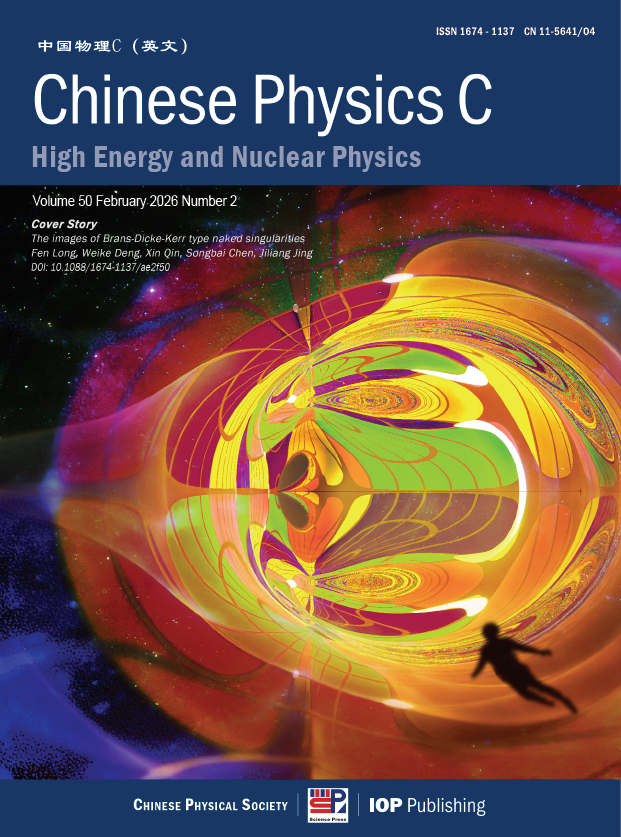
- Cover Story (Issue 2, 2026) |The images of Brans-Dicke-Kerr type naked singularities
- Cover Story (Issue 1, 2026) A focused review of quintom cosmology: from quintom dark energy to quintom bounce
- Cover Story (Issue 11, 2025) The Earth-Magnet Assists DAMPE in Studying Cosmic Anti-Electrons
- Cover Story (Issue 9, 2025): Precise measurement of Ïc0 resonance parameters and branching fractions of Ïc0,c2âÏï¼Ïï¼/ K+K-
- Cover Story (Issue 8, 2025) A Novel Perspective on Spacetime Perturbations: Bridging Riemannian and Teleparallel Frameworks
Advertising